
01
Roof and driveway clearance
Discuss the needed clearance without assuming every overhanging limb must be removed. Rooflines, vehicles and pedestrian routes set different priorities.
More than a shorter canopy.
Good pruning has a purpose: remove dead or damaged branches, manage clearance and improve structure while retaining useful foliage. Tell us what is getting in the way—roof contact, low branches, blocked access or storm damage—so the work can address the cause rather than simply make the tree smaller.
A useful scope starts here
Different trees need different decisions. A palm, a young shade tree and a mature oak should not receive the same treatment. A clear pruning scope identifies the branches and clearance goals, considers tree condition and explains how cut material will be removed.
01
Discuss the needed clearance without assuming every overhanging limb must be removed. Rooflines, vehicles and pedestrian routes set different priorities.
02
Identify branches that are dead, damaged or hanging. Removing a concern safely may require controlled access beneath the canopy.
03
A pruning plan can address competing branches and excessive end weight. It cannot make a tree hurricane-proof or eliminate every risk.
DeLand property considerations
Around DeLand homes and commercial properties, discuss the practical use of the space: parking, deliveries, sidewalks, lawn maintenance and the roof. UF/IFAS describes the value of appropriate structural pruning and cautions against topping. Avoid asking for a fixed percentage of foliage to be removed without considering the tree and the objective.
Helpful official resources
UF/IFAS: preparing trees for hurricanes ↗ UF/IFAS: restoring trees after a hurricane ↗From the call to the work zone
01
Explain what needs clearance, which branches worry you and whether there has been recent storm damage.
02
Discuss tree condition, previous cuts, branch structure, access and overhead utilities.
03
Confirm which branches or areas are included, the desired clearance and the handling of debris.
04
Check the agreed work and cleanup. Ask what to monitor and when another assessment may be useful.
Useful answers. No guesswork.
Topping is not a sound substitute for proper pruning. UF/IFAS warns that severe topping can lead to poorly attached regrowth and decay. Discuss targeted pruning based on the tree’s structure instead.
Ask for a species-specific scope. Palm care differs from branch pruning on shade trees; explain whether dead fronds, seed stalks or clearance are the concern. Avoid excessive removal of healthy green fronds.
There is no single schedule for every tree. Species, age, growth, condition, previous work and nearby structures matter. Request an assessment rather than automatically repeating heavy annual cuts.
No. Pruning can address identified defects and clearance needs, but weather, hidden defects and changing conditions remain. Reassess a tree after significant damage or a noticeable change.
It should describe the pruning objective, trees included, specific clearance or branch work, equipment access and debris removal. “Trim everything” leaves too much open to interpretation.
Keep your whole project connected
Explain which roof edge, walkway or driveway needs clearance. Identify valued shade trees and ask how the proposed pruning balances that objective with tree condition.
Point out pedestrian routes, parking spaces, signs and delivery access. Coordinate the work area with the person responsible for the property rather than leaving occupants to navigate falling debris.
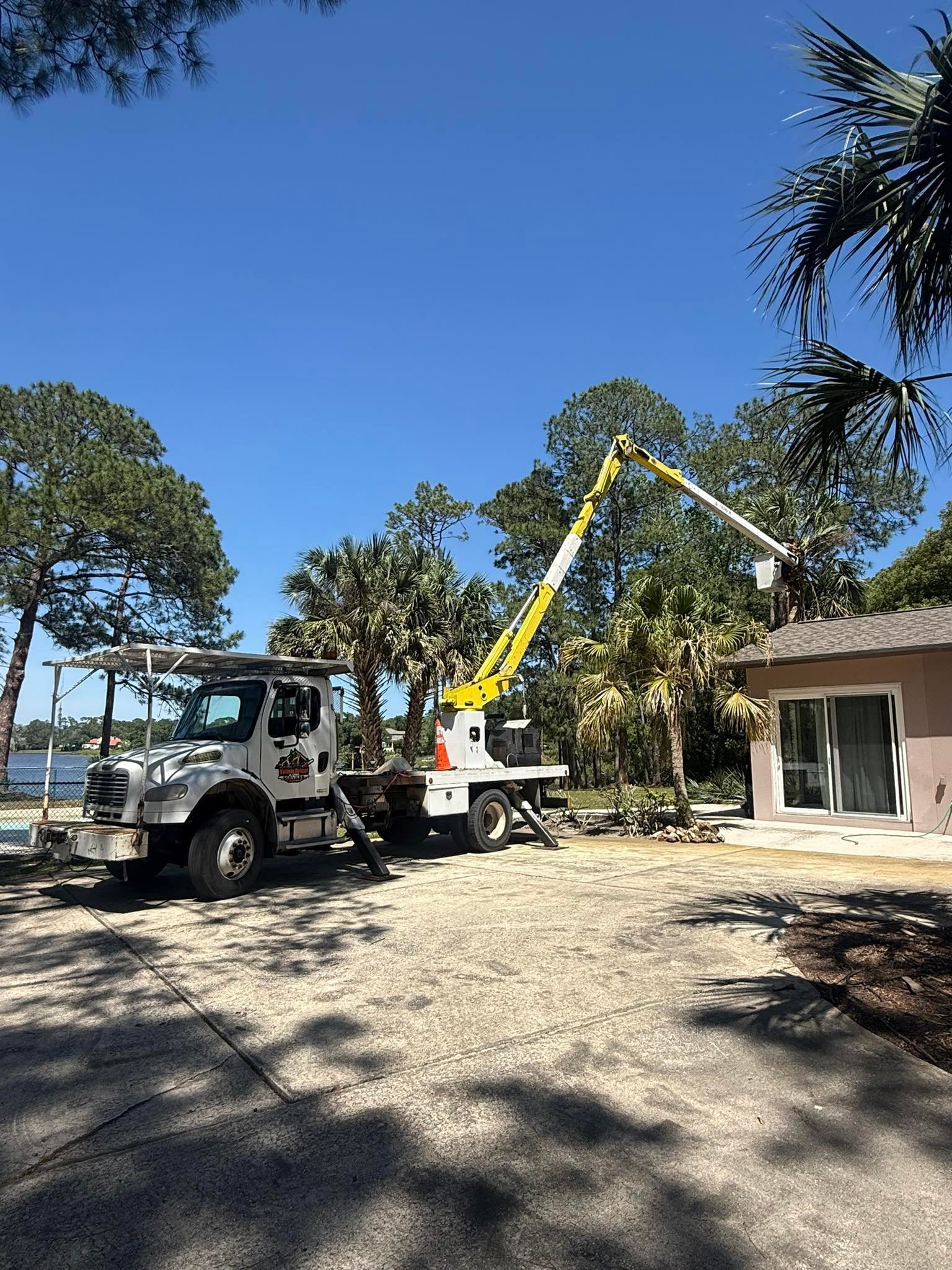
Discuss whether branches can be reached by climbing or whether lift access is needed. Gate widths, truck setup and nearby wires affect the assessment and should be raised before work is priced.
Have a property near DeLand? Share its exact address and access details. See the DeLand service-area guide for local planning information.
Plan your next step
Point out the roof edge, driveway, walkway or branch of concern. Ask which cuts address that goal.
Use the pruning checklist →Identify the trees and branches included, equipment access, debris handling and any exclusions.
See estimate factors →A newly split trunk, changed lean or suspended limb needs assessment before it is treated as routine maintenance.
Read urgent-hazard guidance →Your next step
Tell us where the property is in DeLand, what needs attention and how to reach you. We’ll use those details to discuss an estimate. For an active hazard, call instead.
(386) 675-7898Free estimates • Residential & commercial
A few details help us plan the next step.